
All about it: Posture.
Built to Move, Forced to Sit: What a Chair Is Doing to Your Body
We spend more time sitting than sleeping. For most working adults, the chair has become the default environment — the place where careers are built, emails are answered, meals are eaten, and evenings are passed. It is so ordinary that we rarely stop to ask a basic question: is prolonged sitting actually bad for your body? The answer, written into every joint, muscle, and curve of the human skeleton, is a clear yes.
A Body Designed for Movement — Not a Desk
The human body is the product of roughly two million years of evolutionary pressure applied to a very specific lifestyle: walking long distances, squatting to rest, climbing, carrying, and running in bursts. Our hunter-gatherer ancestors likely covered ten to twenty kilometres per day on foot. When they rested, they did so in deep squats or asymmetrical kneeling — positions that still kept muscles loaded and joints mobile.
The spine reflects this history. Its natural S-curve is a finely tuned shock-absorbing system that distributes compressive forces when we are upright and moving. The hip joint is built to power us through varied terrain. The broad gluteal group drives forward locomotion. Every major structural feature of our anatomy tells the same story: we are distance movers, and motion was never the exception — it was the baseline.
The passive, sustained stillness of office sitting has essentially no precedent in this evolutionary history. Sitting for long periods is, from a biological standpoint, genuinely novel — and our bodies are paying the price.
How the Body Adapts to Prolonged Sitting
Here is what makes the health effects of sitting both remarkable and insidious. The human body is extraordinarily good at adapting to whatever demands are placed upon it. Apply a repeated stimulus, and it reorganises itself — structurally, neurologically, biochemically — to meet that demand more efficiently.
When you sit for eight to ten hours a day, the body does exactly this. It does not protest. It optimises.
Muscles held in a shortened position over months and years actually become shorter. The hip flexors — the deep iliopsoas group — are perpetually contracted while sitting, adapting by reducing resting length and losing extensibility. Meanwhile, muscles that go chronically unloaded do the opposite: they lengthen, weaken, and receive reduced neurological activation. The glutes — the largest and most powerful muscles in the body — are among the worst casualties. This pattern is sometimes called gluteal amnesia: a muscle group so chronically underused that it loses its ability to fire properly on demand.
Fascia — the connective webbing that envelops all structures — remodels around the most common positions it experiences, thickening and stiffening in directions never loaded, robbing joints of the range of motion needed for healthy movement.
None of this is failure. It is the body performing exactly as designed. The tragedy is that the constraint we have handed it to adapt to is a poor one. The body’s plasticity is working perfectly. It is simply sculpting dysfunction.
How Poor Posture from Sitting Causes Long-Term Damage
When poor ergonomics persist for years, quiet adaptations compound into visible, measurable structural changes — the kind that show up on imaging and in the chronic pain patterns that have become almost universal among desk workers.
Tight hip flexors pull the front of the pelvis downward, creating anterior pelvic tilt. The lumbar spine arches excessively to compensate, shifting compressive forces onto the small facet joints at the back of the vertebrae — laying the foundation for chronic lower back pain. The glutes, now lengthened and inhibited, can no longer stabilise the pelvis, shifting the burden onto structures never intended to carry it.
Further up the chain, the sustained forward lean of screen-based work causes the thoracic spine to round excessively — what most people recognise as a hunched upper back. The shoulder blades are pulled forward and outward. The muscles designed to hold them back — the rhomboids and mid-trapezius — grow long and weak, while the chest muscles shorten. Rotator cuff impingement becomes a predictable consequence.
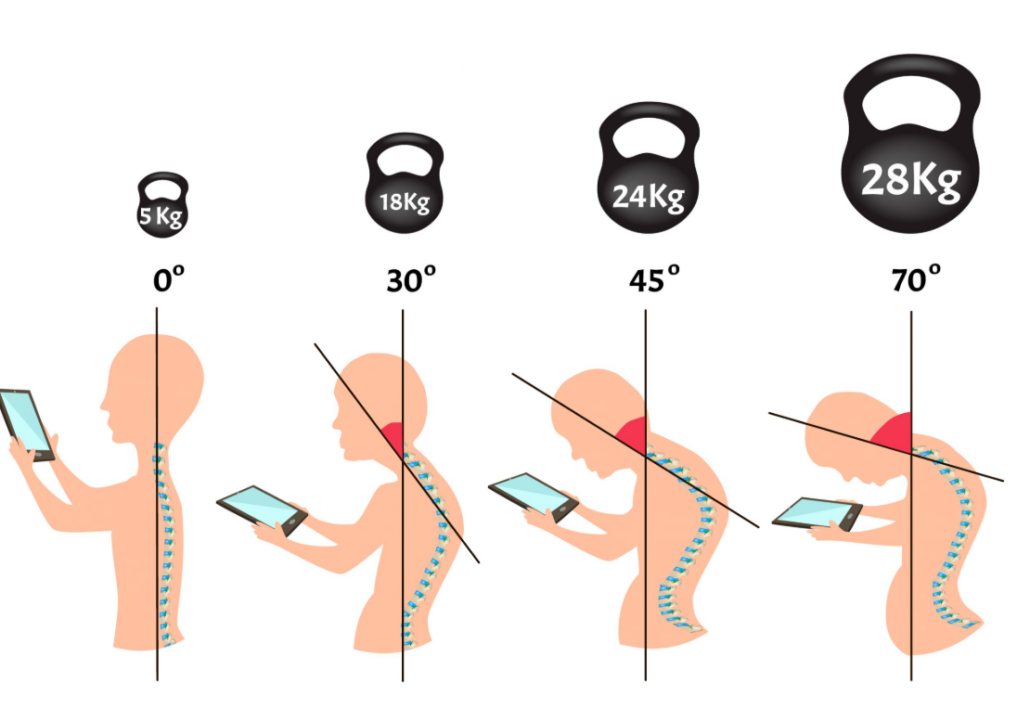
The head, drawn forward toward monitors, creates its own cascade. The cervical spine is designed to carry the head balanced directly over the shoulders — around ten to twelve pounds in a neutral position. At sixty degrees of forward tilt, that effective load can exceed sixty pounds. The result is chronic neck pain, tension headaches, and the stiff, restricted neck that millions of people accept as simply part of modern life.
The ribcage, collapsed by the rounded upper back, loses its ability to fully expand. Breathing becomes shallower and diaphragm function is compromised — with downstream effects on energy, focus, and resting stress levels.
You Cannot Out-Exercise a Chair — But You Can Reverse the Damage
One of the more sobering findings in recent research is what scientists call the “active couch potato” effect. People who meet standard exercise guidelines but spend the remaining hours of their day seated still show musculoskeletal and metabolic profiles resembling those of sedentary individuals. The hour at the gym does not cancel ten hours at the desk.
This is not cause for despair. It is cause for a smarter strategy.
Correcting poor posture requires work that is structured, intentional, and targeted to the specific imbalances sitting has created. The hip flexors need sustained progressive stretching — not the thirty-second variety at the end of a workout, but loaded positions held long enough to genuinely lengthen the tissue. The glutes need deliberate activation work to reestablish the neurological pathways sitting suppresses. The thoracic spine needs extension and rotation to counteract constant flexion. The deep cervical flexors need retraining so the neck is supported from within.
Beyond corrective exercise, the most powerful daily habit is simply breaking up prolonged stillness. Moving briefly every thirty to forty-five minutes — standing, walking, a few hip extension repetitions — interrupts the adaptive cascade at its source.
Get a Postural Assessment at Mission Chiro
The human body is not fragile. It is astonishingly resilient — which is precisely why so many people can sit for years before the consequences become impossible to ignore. But adaptability is not immunity. Every hour in a sustained, static posture is a small deposit into an account of structural debt, and that debt presents its bill in the form of chronic back and neck pain, reduced mobility, and a body reshaped for a life it was never designed to live.
No chair, however expensive, solves a problem that is fundamentally about movement deprivation. But the damage that has accumulated is not permanent — it is reversible with the right approach. At Mission Chiro, our practitioners offer comprehensive postural assessments to identify exactly where your imbalances have taken hold and build a personalised plan to correct them. Whether you’re managing lower back pain from sitting, forward head posture, tight hips, or reduced mobility, we can help you get ahead of the damage before it becomes harder to reverse.
Book your postural assessment with Mission Chiro today.


